Event Overview
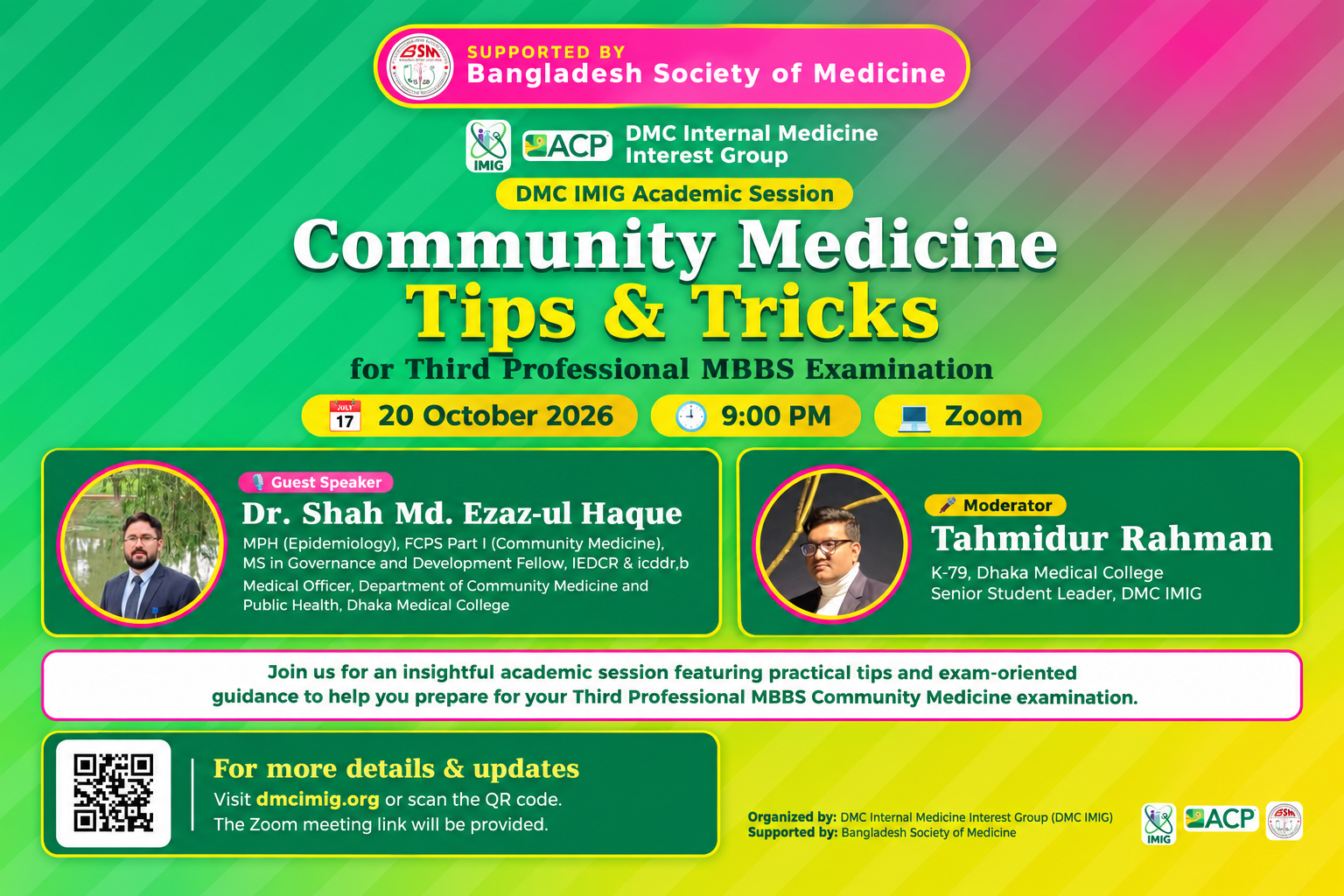
Community Medicine Tips & Tricks for the Third Professional MBBS Examination
The DMC Internal Medicine Interest Group (DMC IMIG), supported by the Bangladesh Society of Medicine (BSM), hosted an academic session tailored for Third Professional MBBS students preparing for their Community Medicine examination.
The session focused on high-yield, exam-oriented guidance, epidemiological reasoning, biostatistical calculations, practical OSPE stations, and viva voce preparation.
Further details and updates are available on the DMC IMIG website: dmcimig.org
Zoom Meeting Access DetailsLive Broadcast
- Platform: Zoom Cloud Meetings
- Topic: Community Medicine Tips & Tricks for Third Professional MBBS Examination
- Date & Time: Tuesday, 20 October 2026 at 09:00 PM BST (Dhaka Time)
- Direct Zoom Link: Join Zoom Meeting
- Join & Take Notes: Join and Take Notes on Zoom
- Meeting Chat: Open Zoom Meeting Chat
- Meeting ID:
271 784 5600 - Passcode:
DMC-IMIG - Simulcast: Live on DMC IMIG Facebook & YouTube channels
- Fee: Completely Free for all medical students (No prior registration required)
Distinguished Guest SpeakerGuest Speaker
Dr. Shah Md. Ezaz-ul Haque
- Medical Officer, Department of Community Medicine and Public Health, Dhaka Medical College
- MPH (Epidemiology)
- FCPS Part I (Community Medicine)
- MS in Governance and Development Fellow, IEDCR & icddr,b
- An experienced public health physician and educator specializing in disease surveillance, epidemiological investigation, biostatistics, and student mentorship for undergraduate examinations.
Session ModeratorModerator
Tahmidur Rahman
- K-79, Dhaka Medical College
- Senior Student Leader, DMC IMIG
What This Session Covered
1. Written Examination Strategy & High-Scoring Approaches
Mastering question analysis, structured answers, and time management across both papers:
- Structured Public Health Answers: How to organize epidemiology answers (Definition, Classification, Indicators, Pathogenesis/Etiology, Prevention, Control, and National Program).
- High-Yield Definitions: Exact WHO and textbook definitions that examiners expect verbatim (Epidemiology, Health, Surveillance, Herd Immunity, Incidence, Prevalence).
- Flowcharts & Programmatic Diagrams: Drawing clear surveillance chains, levels of prevention, cold chain maintenance, and disease transmission cycles to secure full marks.
2. Epidemiology & Study Designs
Deconstructing study designs and causality criteria tested heavily in written exams and viva boards:
- Observational Studies: Descriptive vs. analytical studies (Cross-sectional, Case-Control, Cohort studies).
- Measures of Association: Odds Ratio (OR), Relative Risk (RR), Attributable Risk (AR), and interpreting 2x2 contingency tables.
- Experimental Studies & Trials: Randomized Controlled Trials (RCTs), blinding techniques, and ethical considerations.
- Bias, Confounding & Bradford Hill Criteria: Identifying systematic errors, confounding variables, and criteria for causal relationships.
3. Biostatistics Demystified
Solving calculations and interpreting statistical findings with confidence:
- Measures of Central Tendency & Dispersion: Mean, median, mode, standard deviation, and variance.
- Normal Distribution Curve: Characteristics, 68-95-99.7 rule, and skewness.
- Tests of Significance: Student's t-test, Chi-square test, p-value interpretation, and Type I vs. Type II errors.
- Sampling Methods: Probability sampling (simple random, stratified, cluster) vs. non-probability sampling.
4. Communicable Diseases, Outbreak Investigation & Immunization
Navigating national health programs, vaccination, and field investigations:
- Outbreak Investigation: 10 systematic steps of epidemic investigation and epidemic curves.
- Expanded Programme on Immunization (EPI): Bangladesh national schedule, vaccine types, routes, storage temperatures, and cold chain equipment.
- Vector-Borne & Infectious Diseases: Dengue, malaria, tuberculosis (DOTS regimens), cholera, and rabies post-exposure prophylaxis protocols.
5. Maternal and Child Health (MCH), Nutrition & Demography
Core community health indicators and reproductive health standards:
- Maternal & Child Health Indicators: Maternal Mortality Ratio (MMR), Infant Mortality Rate (IMR), Under-5 Mortality Rate (U5MR), and antenatal care schedules.
- Nutrition & Public Health Deficiencies: Protein-energy malnutrition (PEM), Mid-Upper Arm Circumference (MUAC), vitamin deficiencies, and community nutrition interventions.
- Demography & Family Planning: Demographic stages, total fertility rate, contraceptive methods, and calculation of couple-years of protection.
6. Practical, OSPE Stations & Viva Voce Guidance
Succeeding in OSPE stations, instruments, vaccines, and the viva board:
- OSPE Station Navigation: Spotting public health instruments (chlorometer, sling psychrometer, kathathermometer, vaccines, contraceptive devices, nutritional scales).
- Statistical & Epidemiological Problems: Rapid calculation of incidence rates, sensitivity, specificity, and positive predictive values.
- Viva Voce Traps & Tips: Handling examiner favorite topics, environmental health parameters, sanitary wells, and demonstrating calm, confident clinical communication.
Event Logistics & SummarySchedule
- 📅 Date: 20 October 2026 (Tuesday)
- ⏰ Time: 09:00 PM BST
- 📍 Platform: Zoom Cloud Meetings (Interactive Academic Session)
- 📺 Broadcast: Live Simulcast on DMC IMIG Facebook & YouTube
- 👥 Audience: Medical students of all medical colleges, 3rd Prof examinees.
- 💵 Admission: Completely Free (No registration required - Direct Join via Zoom).
Organizers & Academic Partners
| Role | Organization | Description |
|---|---|---|
| Organized by | DMC Internal Medicine Interest Group (DMC IMIG) | |
| Supported by | Bangladesh Society of Medicine (BSM) |
Delegate Feedback & Discussion0
Share your insights, reflections, and questions about this clinical session
Please log in to leave your thoughts. You can choose to post under your real account or anonymously with a unique badge.