Event Overview
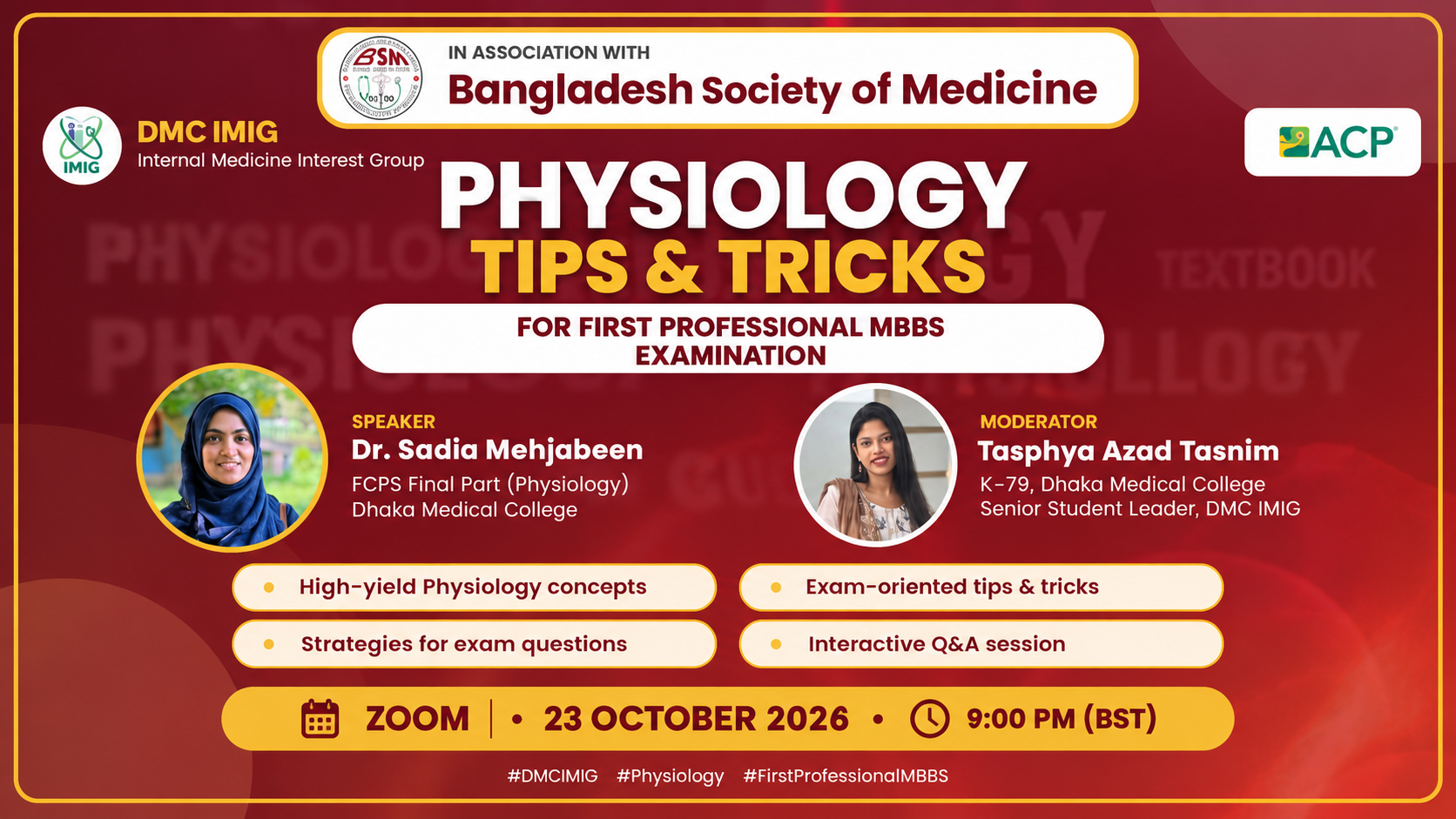
Physiology Tips & Tricks for the First Professional MBBS Examination
The DMC Internal Medicine Interest Group (DMC IMIG), in association with the Bangladesh Society of Medicine (BSM), hosted an interactive academic session tailored for First Professional MBBS students preparing for their Physiology examination.
The session focused on high-yield physiology concepts, exam-oriented tips and tricks, strategies for written exam questions, OSPE station navigation, and viva voce mastery.
Further details and updates are available on the DMC IMIG website: dmcimig.org
Zoom Meeting Access DetailsLive Broadcast
- Platform: Zoom Cloud Meetings
- Topic: Physiology Tips & Tricks for First Professional MBBS Examination
- Date & Time: Friday, 23 October 2026 at 09:00 PM BST (Dhaka Time)
- Direct Zoom Link: Join Zoom Meeting
- Join & Take Notes: Join and Take Notes on Zoom
- Meeting Chat: Open Zoom Meeting Chat
- Meeting ID:
271 784 5600 - Passcode:
DMC-IMIG - Simulcast: Live on DMC IMIG Facebook & YouTube channels
- Fee: Completely Free for all medical students (No prior registration required)
Distinguished Guest SpeakerGuest Speaker
Dr. Sadia Mehjabeen
- FCPS Final Part (Physiology), Dhaka Medical College
- An accomplished educator and clinical physiologist dedicated to teaching undergraduate medical students, simplifying complex physiological pathways, and preparing candidates for First Professional MBBS distinction.
Session ModeratorModerator
Tasphya Azad Tasnim
- K-79, Dhaka Medical College
- Senior Student Leader, DMC IMIG
What This Session Covered
1. Written Examination Strategy & High-Scoring Techniques
Mastering structure, presentation, and time management across Paper I and Paper II:
- Structured Physiological Answers: How to organize answers (Definition, Mechanism, Pathway/Flowchart, Physiological Significance, and Clinical Application).
- Flowcharts & Feedback Loops: Drawing negative and positive feedback loops (hormonal axes, baroreceptor reflex, blood clotting cascades) to capture full marks.
- Diagram Mastery: Essential schematics examiners expect (Wiggers diagram, Action potential tracing, Oxygen-Hemoglobin dissociation curve, Countercurrent multiplier).
2. Nerve-Muscle Physiology & Hematology
Deconstructing foundational principles tested in both written papers and oral examinations:
- Excitable Tissues: Genesis of resting membrane potential, ionic basis of action potential, neuromuscular transmission, and excitation-contraction coupling.
- Blood & Hemostasis: Erythropoiesis regulation, hemoglobin synthesis, extrinsic and intrinsic coagulation pathways, fibrinolysis, and blood group immunology.
- Clinical Correlations: Myasthenia gravis, anemia classifications, hemophilia, and transfusion mismatch management.
3. Cardiovascular & Respiratory Systems
Core systemic physiology that anchors First Professional examinations:
- Cardiovascular Dynamics: Cardiac cycle phases, cardiac output determinants (preload, afterload, contractility), Frank-Starling law, and arterial blood pressure regulation.
- Electrocardiogram (ECG): Waveforms, intervals, cardiac vector orientation, and recognizing common arrhythmias.
- Respiratory Mechanics: Lung volumes and capacities, compliance, surfactant dynamics, ventilation-perfusion matching, and oxygen-carbon dioxide transport mechanisms.
4. Renal, Fluid-Electrolyte & Acid-Base Physiology
Conquering kidney function and internal homeostasis:
- Renal Dynamics: Glomerular filtration rate (GFR) regulation, tubuloglomerular feedback, and tubular transport mechanisms.
- Urine Concentration Mechanism: Countercurrent multiplier and exchanger systems, and role of ADH and aldosterone.
- Acid-Base Balance: Buffer systems, respiratory compensation, renal regulation of bicarbonate, and interpreting arterial blood gas (ABG) charts.
5. Gastrointestinal Physiology & Endocrinology
Systemic control mechanisms and chemical messengers:
- Endocrine Signaling: Hypothalamic-pituitary axes, thyroid hormone regulation, calcium homeostasis (PTH, calcitonin, vitamin D), and adrenal cortical function.
- Digestive System: Gastric acid secretion regulation, pancreatic juice control, bile secretion, and intestinal absorption mechanisms for nutrients and electrolytes.
6. Central Nervous System, Sensory Pathways & Practical/OSPE
Navigating neurophysiology, sensory systems, practical journals, and viva boards:
- Neurophysiology: Ascending sensory tracts (dorsal column vs. anterolateral), pyramidal and extrapyramidal motor systems, reflexes, and cerebellar functions.
- OSPE Station Navigation: Hematology practicals (ESR, Hb estimation, blood grouping, RBC/WBC count calculation), spirometry interpretation, and blood pressure measurement technique.
- Viva Voce Traps & Tips: Answering physiological definitions crisply, explaining regulatory mechanisms without hesitation, and maintaining calm under pressure.
Event Logistics & SummarySchedule
- 📅 Date: 23 October 2026 (Friday)
- ⏰ Time: 09:00 PM BST
- 📍 Platform: Zoom Cloud Meetings (Interactive Academic Session)
- 📺 Broadcast: Live Simulcast on DMC IMIG Facebook & YouTube
- 👥 Audience: Medical students of all medical colleges, 1st Prof examinees.
- 💵 Admission: Completely Free (No registration required - Direct Join via Zoom).
Organizers & Academic Partners
| Role | Organization | Description |
|---|---|---|
| Organized by | DMC Internal Medicine Interest Group (DMC IMIG) | |
| Supported by | Bangladesh Society of Medicine (BSM) |
Delegate Feedback & Discussion0
Share your insights, reflections, and questions about this clinical session
Please log in to leave your thoughts. You can choose to post under your real account or anonymously with a unique badge.